AI Series · Level 2 · For the Generation That Will Run It

Under the Hood & Ahead of the Curve

You know how to use AI. Now understand how it actually learns, how it becomes an agent that acts, the hard problems nobody has solved yet, and how to build a career on the right side of this wave.

Haven’t done AI 101 → yet? Start there.

Go Deeper →
Module 1

How a Machine Actually “Learns”
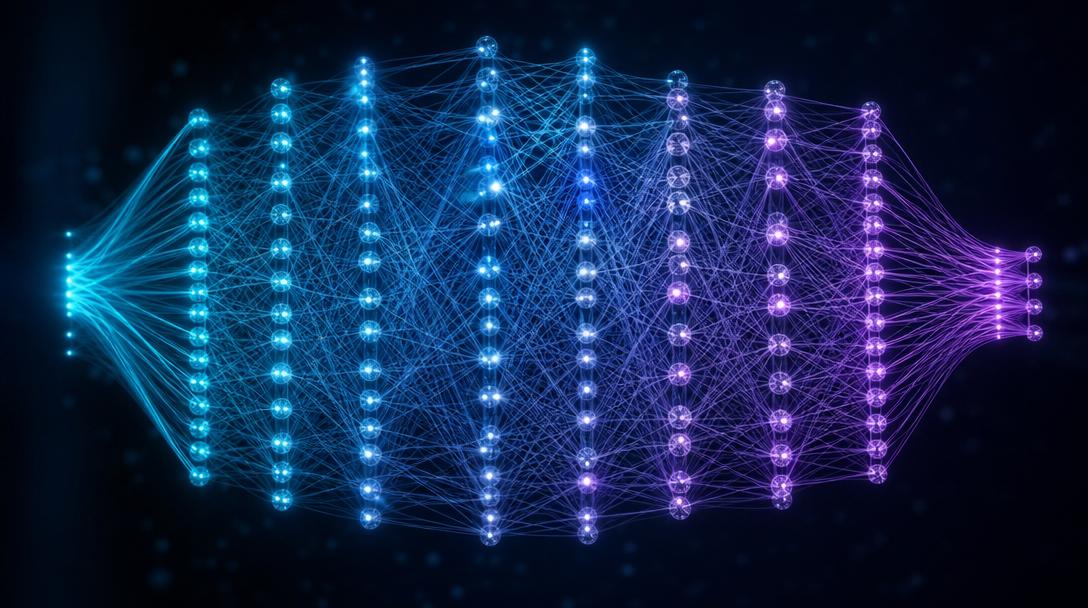
A deep neural network

Inside every model is a neural network: layers of simple math units ("neurons") connected by millions — or billions — of adjustable dials called weights (or parameters). Learning is just tuning those dials. Walk the training loop:

Why "scale" is a big deal: more data + more parameters + more computing = better predictions. That’s why the frontier is a race for chips and energy (the stuff you saw in the Future Quests). Bigger models, trained on more, simply learn more patterns.

Module 2

The AI Landscape

"AI" isn’t one thing. Know the main families you’ll meet:

💬

Language models (LLMs)

Predict and generate text. Power chatbots, writing, coding, tutoring. E.g. ChatGPT, Claude, Gemini.

🎨

Diffusion / generative media

Turn noise into images, video, and audio from a prompt. E.g. Midjourney, Sora, image tools.

🧭

Multimodal models

Handle text + images + audio together — see a photo, read it, and talk about it.

🤖

Agents

Models given tools and goals so they can do tasks, not just chat (next module).

Open vs. closed: some models are closed (used through a company’s app/API — ChatGPT, Claude); others are open-weight (you can download and run them yourself — Llama, Mistral). Open = more control & privacy; closed = usually more powerful and easier.
Module 3

From Chatbot to Agent

An AI agent using tools

A chatbot talks. An agent acts — give a model tools (search, code, a calendar), memory, and a goal, and it can take real steps to finish a task on its own.

Chatbot
Agent
Answers your question
Breaks a goal into steps and does them
Forgets after the chat
Remembers and builds on past steps
Only words
Uses tools: search, code, apps, files
You do the work
It drafts, checks, and iterates for you
RAG (Retrieval-Augmented Generation): the trick that lets AI answer from your documents instead of just its training. It "looks up" relevant info first, then answers — fewer hallucinations, current facts. It’s how most real company AI tools work.
Module 4

Building With AI (You Don’t Have to Be a Coder)

You can create real things on top of these models. The ladder from user → builder:

🧱

No-code

Tools like GPT "custom bots," automation apps, and site builders let you ship an AI product with zero code.

🔌

APIs

A few lines connect your app to a model. This is how developers add AI to anything — the model becomes a building block.

🛠️

Fine-tuning & RAG

Feed a model your own data so it speaks your style or knows your stuff. How companies customize AI.

Portfolio move: the single best thing a graduate can do right now is build and ship one real AI-powered thing — a study bot, a tool for a club, an automation for a job. It beats any certificate.
Module 5

The Hard Problems Nobody Has Solved

AI alignment and governance

The most powerful technology of your lifetime comes with genuinely unsolved problems — and your generation will inherit them. Tap each to understand it.

Why you should care: these aren’t just engineers’ problems. They’re decided by voters, lawyers, writers, founders, and citizens — the roles you’re about to step into. This is the “conscience” layer, and it needs humans.
Module 6

Your Career on the Right Side of the Wave

AI won’t take every job — but it will reshape almost all of them. The strategy is a barbell: work AI can’t easily touch, or work that builds and steers AI. Avoid the easily-automated middle.

🫱

The human end

Hands, heart, trust, judgment — care, trades, leadership, persuasion, craft. Hard to automate, always needed.

🚀

The frontier end

Build and govern the wave — AI, chips, energy, robotics, biotech, and AI policy & safety.

🧭

Judgment

Deciding what’s worth doing — the scarce skill.

🔁

Learning to learn

The tools change yearly; adaptability compounds.

🗣️

Communication

Explaining, persuading, leading humans.

🧩

Be T-shaped

Broad AI literacy + one deep skill you own.

Final

🎓 The Capstone

Ten questions across everything in AI 201. Earn your badge — and your edge.

Reference

📖 AI Glossary 2.0

Neural networkLayers of connected math units, loosely inspired by the brain, that learn patterns.
Parameters / weightsThe billions of adjustable dials a model tunes during training.
TrainingRepeatedly predicting, measuring error, and nudging weights to reduce it.
AgentA model given tools, memory, and goals so it can take actions, not just chat.
RAGRetrieval-Augmented Generation — letting AI answer from your own documents.
Fine-tuningExtra training on your data to specialize a model.
Open-weightA model you can download and run yourself.
AlignmentMaking AI reliably do what humans actually want and intend.
MultimodalHandling text, images, and audio together.